Why is the 5th harmonic used to detect transformer overexcitation?
This is somewhat interesting because numerous harmonics could be chosen for detecting transformer overexcitation.
Why do transformers produce harmonics when they’re overexcited?
A transformer has a volt-second rating for its core. That’s basically the integral of the voltage waveform for each half cycle. Conceptually, the core can only be pushed so far in one polarity before all the iron domains line up with the magnetic flux. At that point, the core stops being an efficient path; it saturates, and flux starts spilling into the air, oil, and tank walls.
Think of it with DC: apply it long enough and eventually all domains line up. With AC, saturation happens if the volt-second rating is exceeded on either half cycle. Voltage magnitude stretches things along the y-axis of a voltage vs. time plot, while frequency compresses or expands along the x-axis.
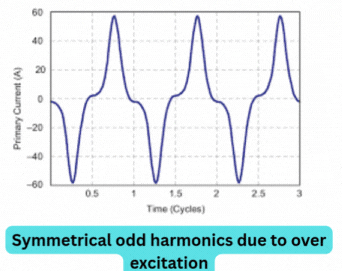
When voltage is excessive, the sine wave collapses as soon as the core’s volt-second rating is exceeded. The higher the overvoltage, the earlier this collapse happens in the cycle. Harmonics, both voltage and current, are produced in that transition from flux staying in the core to flux leaking outside. Deep saturation is sometimes called “super-saturation.” Air doesn’t technically saturate, but it also doesn’t couple flux efficiently. Most of the time, what we call saturation is really this transitory region between core and air linearity
These distortions show up as harmonics. On the secondary, voltage harmonics are impressed as flux transfer varies. On the primary, current and voltage harmonics appear because the excitation current is nonlinear.
Why odd harmonics?
Because saturation happens symmetrically on both positive and negative half cycles, the resulting harmonics are odd. Even harmonics usually point to asymmetry or quasi-DC. That does happen in transformers during inrush, which is why the 2nd harmonic is used for detecting energization and blocking tripping.
So why the 5th?
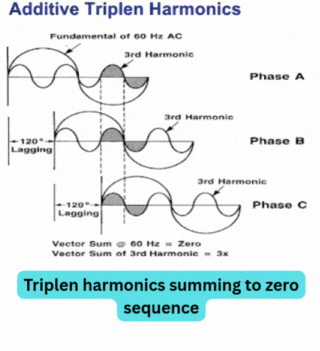
The first odd harmonic is the 3rd. The problem is that it’s a triplen harmonic, which behaves like zero-sequence. The amount of 3rd-harmonic current during overexcitation depends heavily on grounding; grounded systems draw more, ungrounded systems less. On top of that, other loads also produce triplen harmonics, which can flow through the transformer’s ground and muddy the signal.
The next option is the 5th. It doesn’t behave like zero-sequence, isn’t affected by grounding, and doesn’t attract stray triplen harmonics from other loads. That’s why the 5th harmonic is usually chosen for detecting overexcitation.